 |
 |
 |
Plagiarism Check
Publication Ethics
Plagiarism Policy
JOCSAIC strongly opposes plagiarism and self-plagiarism. The journal is committed to maintaining originality, academic integrity, and ethical publication standards.
Originality Requirement
Commitment to Preventing Plagiarism
JOCSAIC strongly opposes any case of plagiarism in scholarly publishing and is committed to preventing plagiarism, including self-plagiarism.
Authors must ensure that they have written entirely original work. When authors use the work, ideas, or words of others, these sources must be appropriately cited or quoted. Papers found to contain plagiarism or improper citation practices will be automatically rejected, and authors will be strongly advised regarding the issue.
Similarity Screening
Turnitin and iThenticate Check
The Journal of Computer Science, Artificial Intelligence, and Communications rejects all forms of plagiarism. Editors will conduct plagiarism checks using Turnitin and iThenticate to identify similarity and potential plagiarism in submitted manuscripts.
Similarity Threshold
Maximum Similarity: 25%
An article is considered to contain plagiarism if more than 25 percent similarity is found after filtering in a similarity check. Articles suspected of plagiarism will be returned immediately, and the author(s) may have their work rejected for 3 (three) years.
Definition
What Is Plagiarism?
Plagiarism refers to the use of another person's ideas, concepts, statements, or writings without proper attribution to the source. Plagiarism is a moral violation that falls into the category of intellectual theft. Failure to provide proper academic references is a serious violation and may be subject to legal consequences, including Article 113 of Law No. 28 of 2014 on Copyright.
Plagiarism Categories
What Can Be Categorized as Plagiarism?
According to the Indonesian Ministry of Education Regulation No. 17/2010 concerning the Prevention and Combating of Plagiarism in Higher Education, Chapter II, Article 2, paragraph (1), plagiarism includes but is not limited to the following actions:
A. Uncited Terms, Words, or Sentences Referring to and/or quoting terms, words, and/or sentences without mentioning the source in citation notes and/or without adequately stating the source.
B. Random or Improper Quotation Randomly referring to and/or quoting terms, words, sentences, data, and/or information from a source without mentioning or adequately stating the source.
C. Uncited Ideas or Theories Using sources of ideas, opinions, views, or theories without adequately citing the source.
D. Improper Paraphrasing Formulating words, sentences, ideas, opinions, views, or theories in one's own language without adequately citing the original source.
E. Submitting Another Party's Work Submitting a scientific work produced and/or published by another party as one's own scientific work without adequately citing the source.
Citation Obligation
What Sources Should Be Cited?
Ideas and Concepts
Every work, idea, and concept of others must be cited properly.
Paraphrased Material
Every paraphrase of another person's work, idea, or concept must refer to the original source.
Direct Quotations
Every quotation, whether partial or complete, must be enclosed in quotation marks and referenced to the original source.
Prevention Guidance
How to Avoid Plagiarism
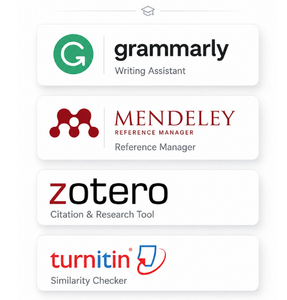
Use Reference Managers Use citation applications such as Mendeley, Zotero, or EndNote to manage references accurately.
Record Sources Immediately Immediately note every source used in the manuscript. Do not delay recording citation information.
Cite Paraphrased Ideas Even in paraphrasing, authors must include references showing where the ideas were taken from.
Add Scholarly Analysis Include analysis, responses, affirmations, or rebuttals to the ideas of cited authors.
Use Plagiarism Checker Applications Before submitting an article, authors are encouraged to use plagiarism checker applications such as Turnitin, Grammarly, or iThenticate.
Integrity in Scholarly Publishing
Through this plagiarism policy, JOCSAIC upholds academic honesty, responsible authorship, and ethical dissemination of scientific knowledge.